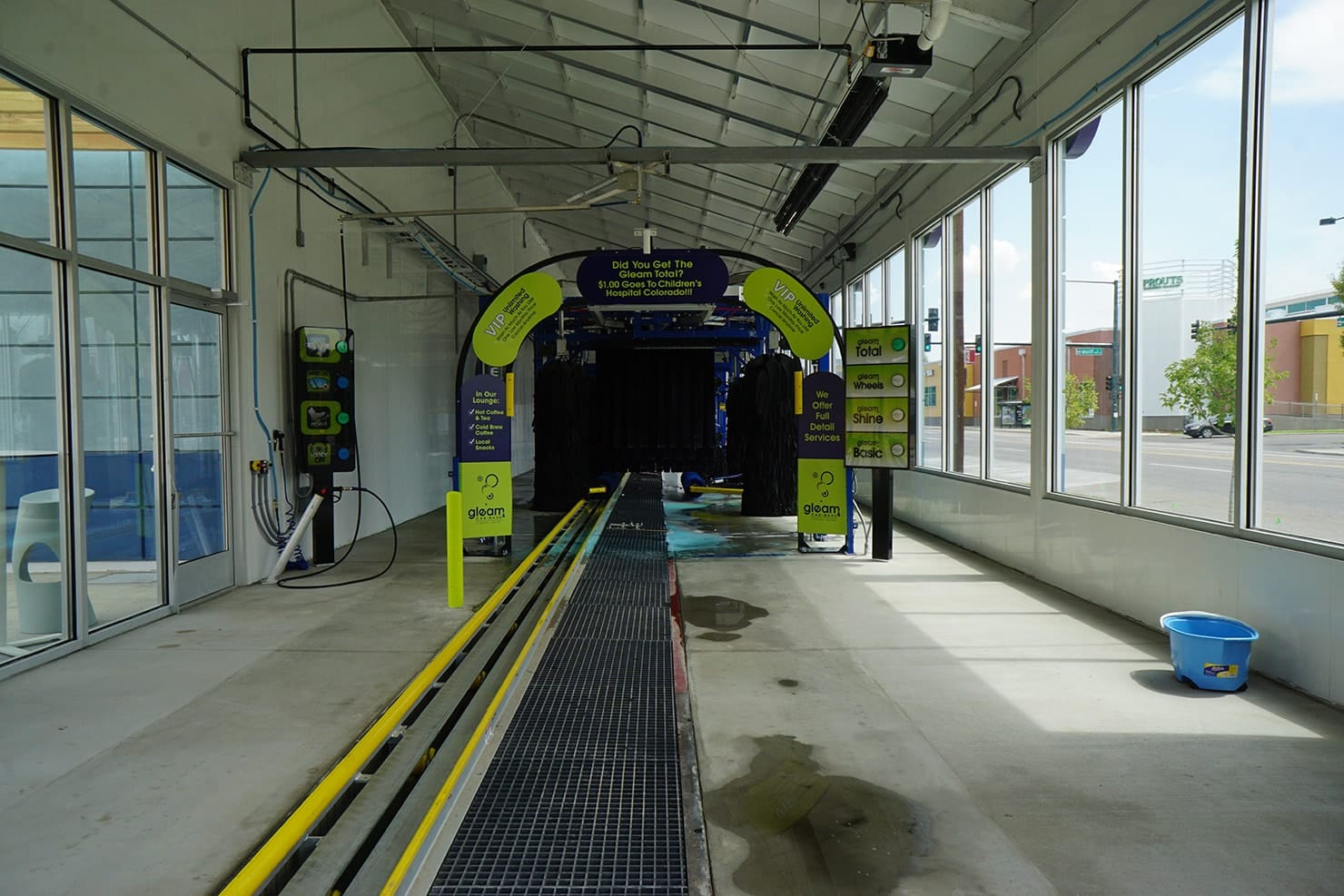
Car wash roofs in Sioux Falls fail from the inside out
A car wash building punishes its roof in a way almost no other commercial structure does, and the damage starts on the underside where nobody looks. Every cycle in the tunnel throws hot water, detergent, tire dressing, and drying-agent mist into the air, and that vapor rises into the deck cavity and condenses against the underside of the steel decking and the heads of the fasteners holding the membrane down. We routinely open up car wash roofs around Sioux Falls and find rusted fastener plates and corroded deck flutes under a membrane that still looks serviceable from above. By the time a stain shows up on the tunnel ceiling, the deterioration has usually been running for years.
We work on every format the local market runs: the express tunnels that have multiplied along Louise Avenue and the 41st Street retail belt, the in-bay automatics tucked behind the convenience stores feeding I-29 and I-90, and the older self-serve bay buildings scattered through the established commercial blocks near downtown. Tommy's, Mister Car Wash, and a steady stream of regional and independent operators have pushed new construction out toward the 85th Street and Tea-Ellis growth edges south of the city, and those newer tunnels carry the most aggressive chemical menus we see anywhere.
Why the tunnel deck is the riskiest roof zone we touch
The stretch of roof directly over the active wash equipment takes the worst of it. Steam, alkaline detergent particulate, and constant thermal cycling from hot-water arches attack the membrane from above while condensation works the deck from below. The three common single-ply membranes do not respond to this the same way. EPDM and TPO can both soften or lose seam strength under sustained alkaline detergent exposure, while PVC holds up far better because its chemistry resists the soaps and waxes used in production washing. For that reason we lean toward a 60-mil fully adhered PVC system over the tunnel itself, and we ask to see the actual chemical program a wash is running before we finalize anything, because two tunnels a mile apart on Louise Avenue can have very different exposure.
Vapor control matters as much as the membrane
Stopping the leak you can see is only half the job on a car wash. If the assembly has no functioning vapor retarder and no path to dry, the interior humidity keeps loading the deck cavity no matter how good the new membrane is. We evaluate the vapor drive for a heated, saturated interior against South Dakota's cold winters, because the freeze-thaw swing here turns trapped moisture into deck corrosion and frozen, delaminated insulation. A car wash roof specified like a dry warehouse roof will not last.
Drainage, canopies, and the details that actually leak
Self-serve and in-bay buildings rarely fail from chemistry first. They fail from ponding. Many of these older bay structures around Sioux Falls were built with minimal slope, and water sits over the equipment room and the bay roofs until the membrane gives up. We add tapered insulation to move water to the drains and scuppers rather than letting it pool above the most sensitive part of the building.
Vacuum canopies and customer canopies are their own problem. They sit in vehicle exhaust and tire-dressing overspray, the metal or membrane covers cook in the open sun, and the connection back to the main building is almost always where the chronic leaks start. We treat every canopy-to-building transition and every canopy drain as a discrete detail rather than assuming the main roof scope covers it.
Winter freeze-thaw is hard on a wet wash roof
South Dakota winters punish a car wash roof in a way that warmer markets never see. The interior runs hot and saturated year-round, so the deck cavity stays loaded with moisture, and then the outdoor temperature drops well below freezing for weeks at a stretch. Any water that has worked its way into the insulation or the deck flutes freezes, expands, and pries the assembly apart, then thaws and refreezes with the next swing. That cycle accelerates the corrosion and delamination that the chemistry already started. It is also why winter water management matters here: meltwater and ice at the canopies and along the edge metal needs a clear path off the roof, because a backup that would simply drain in a milder climate becomes an ice dam in January. We account for both the freeze-thaw exposure and the cold-weather drainage when we spec a wash roof in this market.
What we look at on a car wash inspection
- Underside of the tunnel deck and fastener plates for hidden corrosion
- Membrane and seam condition in the high-vapor wash zone
- Slope and ponding over equipment rooms and bay roofs
- Vacuum and customer canopy covers, gutters, and downspouts
- Exhaust-fan curbs and flashing above the tunnel
- Compatibility of the existing membrane with the chemicals in use
Car Wash Roofing Questions
Why does my car wash roof rust from underneath?
The interior of a working wash stays warm and saturated, and that humid air rises into the deck cavity and condenses on cold steel decking and fastener plates. Over time it corrodes the very fasteners holding your roof down, often with no visible leak until the deck is already compromised. Fixing it means addressing vapor control and drying capacity, not just replacing the surface membrane.
What membrane do you specify over the wash tunnel?
We favor a 60-mil fully adhered PVC system over the tunnel because PVC resists the alkaline detergents, waxes, and drying agents used in production washing far better than TPO or EPDM. Fully adhered eliminates the membrane flutter and the dense fastener field that mechanical attachment would put into a corrosive deck cavity. We confirm the specific chemical program at your facility before locking the spec.
Will chemical exposure void my roof warranty?
Many single-ply warranties exclude chemical exposure outright. Before we specify, we confirm with the manufacturer that the chemistry at your wash is compatible with the membrane and that the warranty covers those conditions. Some manufacturers offer chemical-exposure or car-wash-specific warranties, and we identify those during the specification stage rather than after a denied claim.
Can the work happen without closing the wash?
Usually, yes. Most washes along Louise Avenue and 41st Street run seven days a week, so we sequence the work around your hours. Tunnel roof work often lands in the early-morning or late-evening close window, while canopy and exterior building work can proceed during business hours with traffic control that keeps vehicles clear of the crew.
Do you cover the vacuum and customer canopies?
Yes. Vacuum canopy covers, customer waiting canopies, and the transitions back to the main building are part of our scope assessment. Canopy membrane or panel replacement, gutter and downspout repair, and canopy-to-building flashing are where many express washes leak, so we evaluate them as standalone items.