
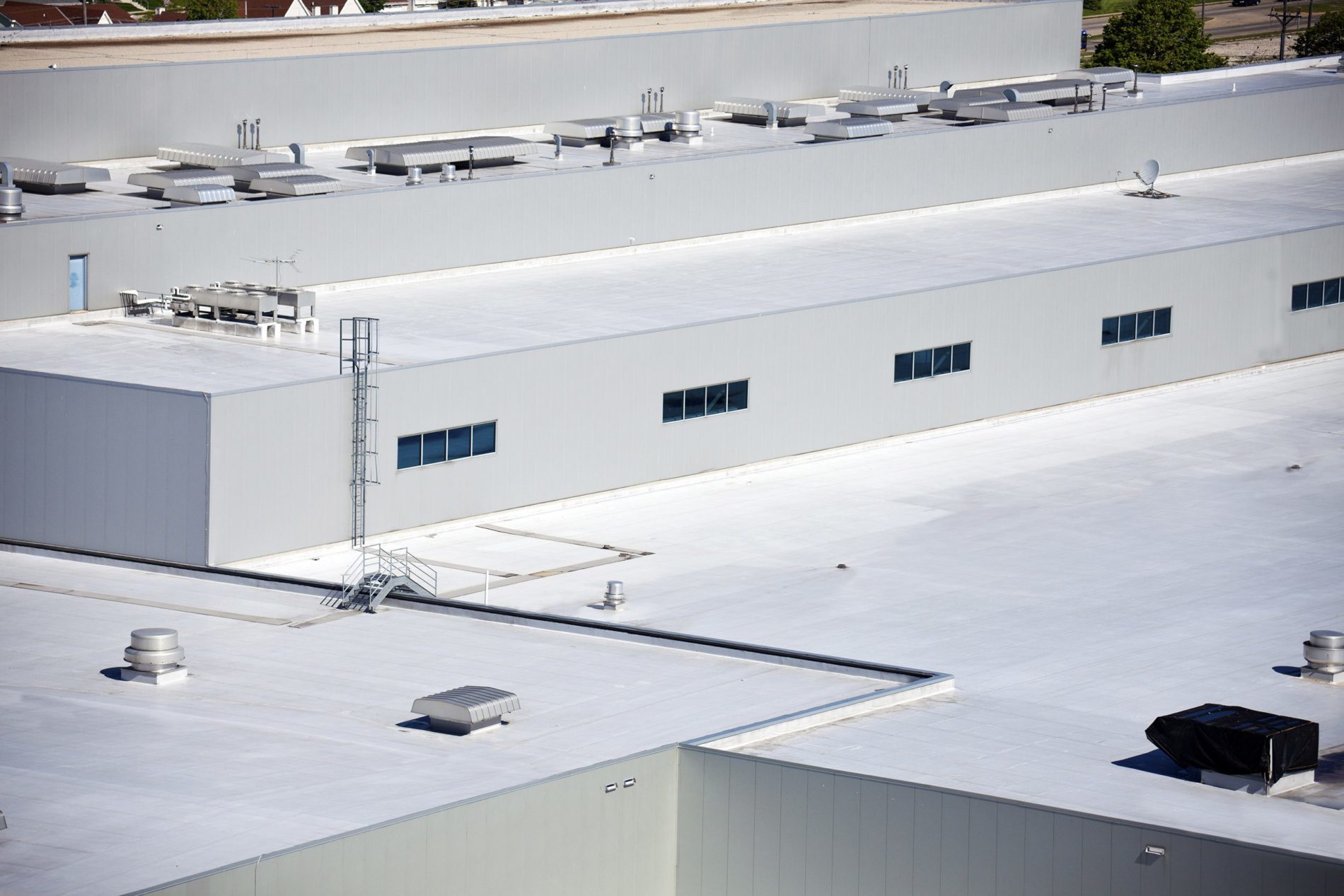
Raven Industries, now a CNH Industrial company operating advanced precision agriculture technology manufacturing in Sioux Falls, anchors a growing industrial base that also includes Smithfield Foods' massive pork processing complex, one of the largest single-site meat processing facilities in North America. These two facilities represent the poles of Sioux Falls manufacturing roofing: one demands precision environmental control for electronics and sensor manufacturing, the other operates in an extreme temperature and humidity environment where ammonia refrigeration systems and high-moisture processing conditions test every roofing component. Contractors in this market must be technically prepared for both ends of the spectrum.
At Raven and similar precision electronics manufacturers, roofing work must address clean process environments where particulate contamination during construction is a real concern. We use containment barriers at all roof-to-wall junctions during construction, restrict adhesive application on windy days to prevent solvent migration into HVAC intake zones, and schedule hot-work activities during periods when facility HVAC systems can be temporarily shifted to recirculation mode. Precision agriculture electronics are sensitive to both particulate and chemical contamination, making contractor discipline as important as technical specification.
Smithfield's processing facility presents an entirely different roofing challenge. Ammonia refrigeration systems running on the roof and through mechanical penthouses create an environment where any membrane exposed to ammonia vapor leaks will degrade rapidly. EPDM, which is commonly used in food processing environments for its cold-temperature flexibility, is incompatible with ammonia, we specify cross-linked polyethylene (XLPE) or modified bitumen systems in ammonia-adjacent zones and confirm all curb penetrations are sealed with ammonia-resistant flashing compounds.
Sioux Falls experiences some of the most demanding thermal cycling of any commercial roofing market in North America. Temperatures swing from minus-twenty degrees Fahrenheit in January to over one hundred degrees in July, a range exceeding one hundred twenty degrees that drives significant membrane expansion and contraction. We select membrane systems with proven cold-temperature flexibility ratings to negative thirty degrees Fahrenheit, use heat-welded seams rather than adhesive bonding in all field applications, and specify insulation boards with dimensional stability ratings appropriate for the climate zone.
Snow load management is a structural priority that roofing work intersects in Sioux Falls. The region's wet, heavy late-season snowfall creates drift accumulations behind rooftop equipment that can exceed design loads on older industrial buildings. Our pre-project assessments include deck capacity review, identification of drift-prone zones behind HVAC units and parapets, and recommendations for either structural reinforcement or equipment relocation where drift accumulation presents a risk. We also design drainage systems that handle rapid snowmelt events, which in Sioux Falls can deliver large water volumes in a compressed time window.
Wind is a constant roofing design factor on the exposed South Dakota plains. Sioux Falls sits in an open landscape where sustained wind speeds and gust factors exceed those in more sheltered markets, driving higher fastening requirements at roof perimeters and corners. We design perimeter fastening patterns to meet or exceed the pressures calculated under ASCE 7 for Sioux Falls, using factory-mutual-approved assemblies and conducting pre-installation pull-tests on existing deck substrate to confirm actual fastener resistance matches design assumptions.
Process exhaust from Smithfield's rendering and cooking operations is high in animal fat particulate, which deposits on roofing surfaces and accumulates around exhaust stack bases in quantities that must be cleaned regularly to prevent drain clogging and membrane degradation. We install grease-resistant TPO or modified bitumen with stainless-steel collars around all processing exhaust penetrations and design the surrounding deck slope to direct drainage away from stack bases rather than allowing grease-laden runoff to pool at low points.
The food processing sector in Sioux Falls has strict operating permits that limit downtime, so scheduling flexibility for roofing work is constrained. Smithfield runs processing operations five to six days per week, and roofing work above active processing lines requires the same overhead protection protocols used in pharmaceutical and semiconductor facilities, continuous temporary protection, no open penetrations over food contact areas, and crew protocols that prevent any roofing material from entering the building envelope during active production.
Energy codes in South Dakota are less prescriptive than coastal states, but the extreme climate makes insulation investment economically obvious regardless of code minimums. We regularly recommend exceeding minimum R-values in re-roofing specifications, particularly for facilities like Raven's electronics manufacturing space where HVAC loads are already high and incremental insulation pays back quickly through reduced heating and cooling costs over a twenty-year roof life.
- Why is EPDM not suitable near Smithfield's ammonia refrigeration systems?
- EPDM is chemically incompatible with ammonia vapor; in zones where ammonia refrigeration lines or mechanical penthouses create vapor exposure risk, XLPE or modified bitumen systems with ammonia-resistant flashing compounds must be specified instead.
- How does Sioux Falls' temperature range affect membrane selection?
- The 120-plus-degree annual temperature swing requires membranes with cold-temperature flexibility ratings to at least negative-thirty Fahrenheit and heat-welded seams rather than adhesive bonding, which loses strength at the low-temperature extreme of this climate zone.
- What wind uplift design standard applies in Sioux Falls?
- We design to ASCE 7 wind pressure calculations for Sioux Falls' open terrain exposure, specifying FM-approved fastening patterns at perimeters and corners and conducting pre-installation pull-tests to verify actual deck resistance matches design values.
- How is snow drift accumulation managed in roofing design?
- Pre-project structural assessments identify drift-prone zones behind rooftop equipment and parapets; where drift loads could exceed deck capacity, we recommend structural review and either equipment relocation or reinforcement before proceeding with roofing work.
- Can roofing work be done above active food processing operations?
- Yes, with strict overhead protection protocols, continuous temporary protection membranes over open sections, no penetrations left open above food-contact areas, and crew protocols preventing any roofing material from entering the building envelope during active processing shifts.