Solar-Ready Roofing for Sioux Falls Commercial Buildings
Bolting solar onto a commercial roof is the easy part. Keeping that roof watertight for the twenty-five-year life of the panels is the part that gets skipped, and it is the part we own. We come at every photovoltaic project from the deck up: before a single rail is set, we want to know what the membrane is made of, how much life it has left, how much weight the structure can take, and who is responsible for every hole that gets punched through a surface that used to be sealed. Get those answers first and the array becomes an asset. Skip them and you have bought yourself a slow leak under a hundred thousand dollars of glass you now have to remove to fix.
Why Sioux Falls owners are asking about this now is no mystery. The flat industrial roofs out by the Foundation Park development on the northwest edge of town, the distribution buildings feeding off the I-29 and I-90 junction, and the meatpacking and food-processing plants that anchor the local economy all run massive electric bills and sit under acres of unshaded membrane. A grocery anchor along 41st Street or a manufacturer in the I-90 industrial belt is looking at a roof that is already the largest flat surface they own and a utility cost they would love to cap. That combination is what puts solar on the table here, and it is exactly the combination that makes the roofing details non-negotiable.
Mounting Choices Drive Everything Else
There are really two families of attachment on a low-slope commercial roof, and picking between them shapes the whole job. A ballasted system rests on top of the membrane and uses concrete blocks to keep the array from sliding or lifting, so it adds almost no penetrations but a serious amount of dead weight. A mechanically attached system fastens through the membrane into the deck or steel below, trading weight for dozens or hundreds of penetrations through a roof that was previously hole-free. Plenty of Sioux Falls roofs can carry a ballasted layout, but the windier the exposure and the lighter the original structure, the more we get pushed toward attachment, and that pulls flashing to the center of the conversation.
Every Penetration Is Ours to Flash
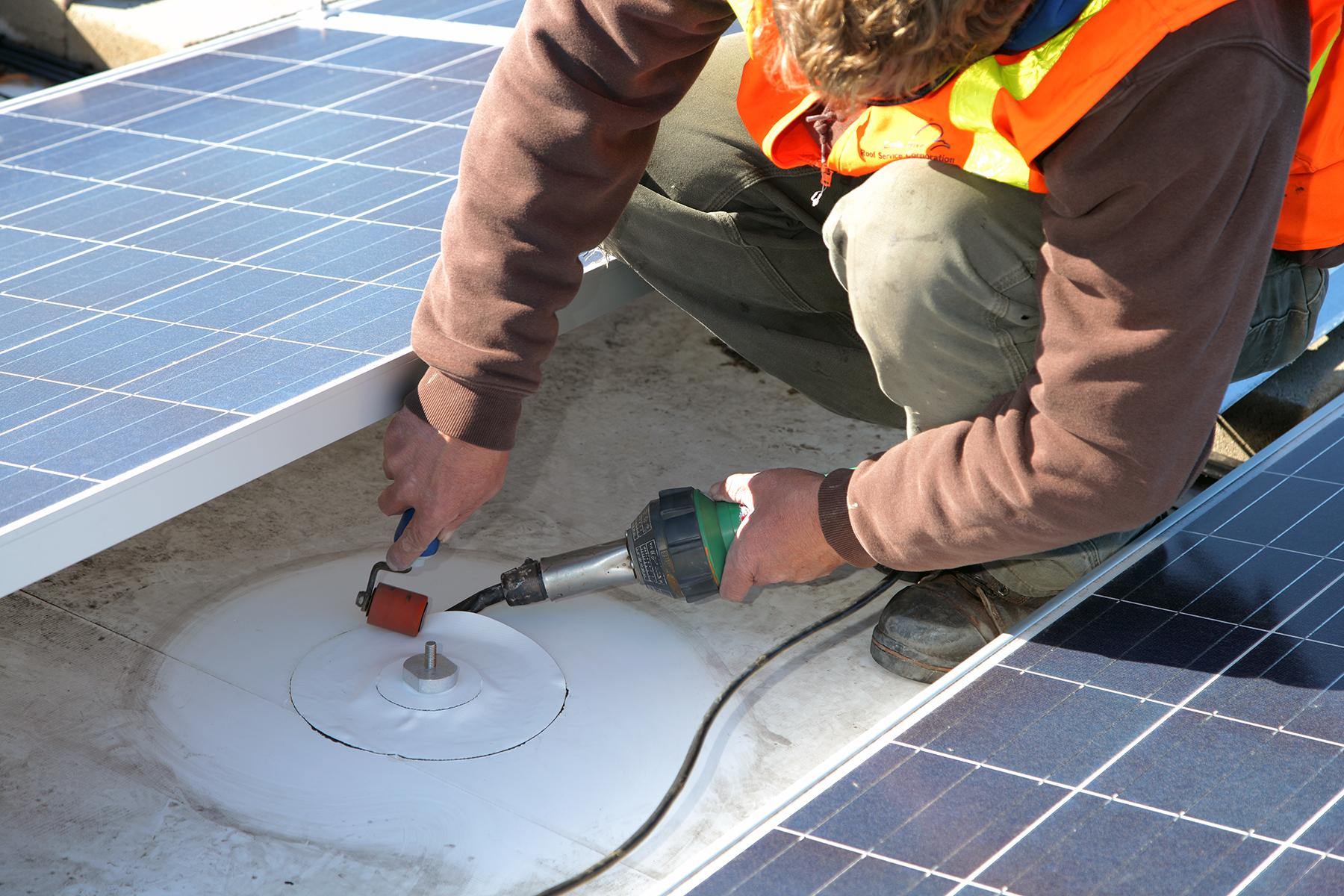
When penetrations are unavoidable, sequence is not a suggestion. We set and flash each stanchion, post base, and curb ourselves, tying it into the field membrane with the manufacturer's published detail, and that work gets inspected before the solar crew lands rail on it. The failure we get called back to three winters later is almost always a mount that a racking installer self-flashed with a tube of mastic and a generic pipe boot. Conduit gets the same discipline: every roof penetration for a homerun, combiner, or grounding run is our flashing to install, and the conduit itself rides on coated rooftop standoffs instead of lying on the membrane where ponding and freeze-thaw cycling will abrade it bare.
Not Every Membrane Belongs Under Panels
Compatibility gets decided before anyone orders racking, not after. Under an array we usually steer owners toward a reflective 60-mil white TPO or PVC, because the cooler surface nudges module output up and the heavier sheet shrugs off the occasional maintenance foot traffic between rows. What we will not do is set new ballast and racking on a thin, weathered, or already-patched membrane, or laminate two chemistries the manufacturer has never approved for contact. Where a building has sound black EPDM with real service life left, we spec slip sheets and ballast pads rated for that specific surface rather than forcing on it a system designed for a different sheet.
Weight and Uplift in Open Prairie Wind
Sioux Falls sits in open country where wind across a rooftop is a design load, not a footnote, and a solar array manages to be both a sail and a pile of dead weight at the same time. A ballasted system can add several pounds per square foot of concrete, which has to be checked against the original deck and joist capacity, an especially live question on the mid-century buildings downtown that were engineered to lighter snow and dead loads than we would assume today. Uplift is the sharper edge: an under-ballasted or unanchored array can lift, walk, or scour the membrane in a straight-line wind event, so the racking design has to reconcile ballast against the building's wind zone and parapet height. When the structure simply cannot carry full ballast, we move to a hybrid or fully attached layout and detail the penetrations that come with it correctly, the first time.
Two Warranties That Do Not Fight Each Other
The quickest way to torch a good roof warranty is to let a solar contractor work on the membrane without ever telling the manufacturer. Most major membrane manufacturers will only keep a no-dollar-limit warranty intact over an array if the system was reviewed in advance, the penetration and walkway pad details match their published requirements, and an authorized installer performs the roof-side work. We sit down for that pre-construction review with the solar EPC, put in writing who owns each penetration, and register the finished assembly so the membrane coverage survives the install. The owner walks away with a roof warranty and a solar warranty that do not contradict each other, instead of two vendors pointing fingers across a stain on the ceiling tile.
Reroof First, or Mount on What You Have?
The one decision that moves the most money is whether to reroof before the panels go up. If the existing membrane has fifteen or more years of documented life left, mounting on it is reasonable and we will say so. If it is down to roughly seven years or less, paying a crew to pull and reset that array during a future tear-off almost always costs more than reroofing now and setting the panels on a fresh surface. We give a blunt remaining-service-life number on the current roof so the solar economics get built on the real figure rather than an optimistic one a sales rep handed over.
What We Deliver on a Solar Project
- A membrane condition assessment and remaining-service-life estimate before any solar commitment is made.
- A penetration, curb, and conduit flashing plan that assigns every roof-side detail to our crew, not the racking installer.
- A ballast-weight and wind-uplift review checked against the building's structure and exposure.
- Manufacturer warranty pre-approval and post-install registration covering the completed array assembly.
- A documented work sequence so all membrane work is flashed and inspected before racking lands on it.
Questions Sioux Falls Owners Ask
Do you have to put holes in the roof? Not always. On a structurally adequate flat roof we favor a ballasted system that needs little or no penetration, and we only move to mechanical attachment when ballast weight exceeds what the deck can carry or when the wind exposure demands it.
Will adding solar void our roof warranty? Only if the work goes around the manufacturer. With a pre-install review, compliant details, and authorized roof-side labor, the membrane warranty stays in force over the array.
Should we replace the roof before installing? If the membrane is down to about seven years or less, reroofing before the install is almost always cheaper than removing and resetting the array later. We size that call around an honest service-life estimate, not a guess.
Do you sell or install the solar equipment? No. We prepare and protect the roof and coordinate with whichever solar installer you choose, so the surface under the array is sound and the two warranties line up.