
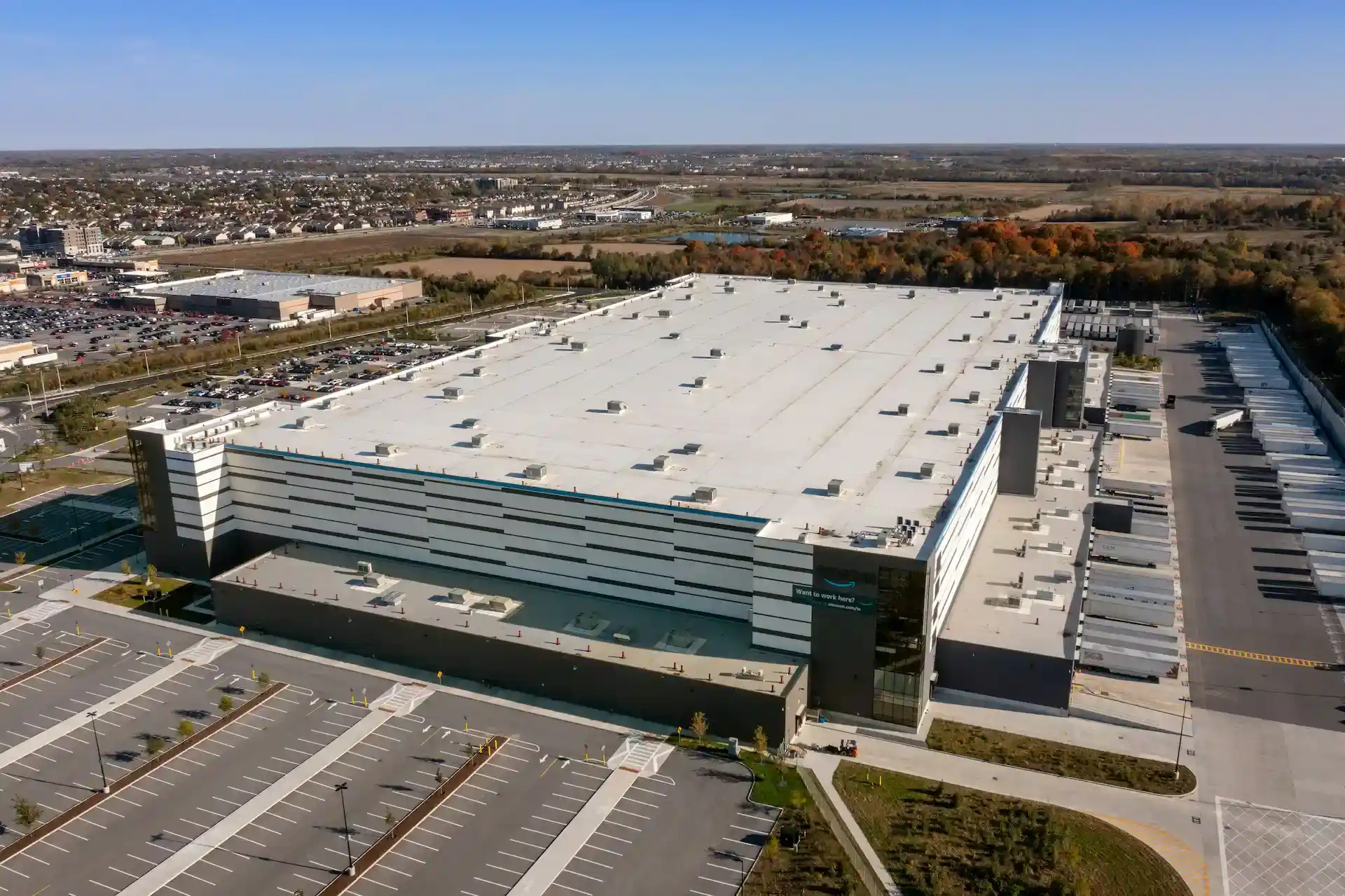
Sioux Falls is the largest city in the Dakotas and a regional logistics hub for the upper Midwest, with facilities like the Scheel's distribution operation and major cold-storage and food processing warehouses along the I-29 and I-90 corridors serving both retail supply chains and agricultural commodity flows. Warehouse roofing in this market demands a specification geared to one dominant climate reality: freeze-thaw cycling that is more severe than almost anywhere else in the contiguous United States, combined with winter snow loads that can exceed thirty pounds per square foot on a flat roof during heavy accumulation years.
Freeze-thaw cycling in Sioux Falls is relentless. The city averages well over 100 freeze-thaw cycles annually, days where the temperature crosses the 32°F threshold in either direction. Each cycle applies expansion and contraction stress to every penetration flashing, every seam edge, and every area of standing water that freezes overnight. EPDM has traditionally been the Midwest freeze-thaw choice because its elasticity allows it to stretch and contract without the surface cracking that early TPO formulations showed in sub-zero temperatures. Modern TPO formulations have improved cold-temperature flexibility significantly, and 60-mil and 80-mil TPO products from major manufacturers are now routinely installed in Dakota winters, but the specification should still require cold-temperature testing data, specifically, the factory-mutual or UL cold temperature crack resistance test results for the specific product being installed.
Snow load management is the most underappreciated roofing issue for Sioux Falls warehouse operators. A 300,000-square-foot roof carrying a 25-pound-per-square-foot snow load is holding 7.5 million pounds of snow, enough to cause structural distress on a building not designed for that accumulation. We review structural drawings before specifying any roof assembly to confirm the dead load capacity and the live load allowance remaining after the new roof system is installed. Adding two inches of polyiso insulation and a new membrane adds roughly three to four pounds per square foot of dead load, which reduces the snow accumulation margin by a corresponding amount. On older Sioux Falls warehouses built in the 1970s and 1980s, this calculation can be critical.
Roof drainage design in a continental climate like Sioux Falls requires consideration for spring snowmelt, which is a different drainage problem than summer rainfall. Spring melt can release a season's worth of accumulated snow moisture over a ten-day period, overwhelming drains that were sized only for peak rainfall intensity. We specify scupper openings through parapet walls at every low point as overflow drainage, and we confirm that those scuppers are clear of ice dams before the spring melt season through maintenance inspections in March. Heated drain leaders, electric heat tape in interior drain pipes, are specified on cold-storage buildings where freezing of the drain line is a real risk.
EPDM recover systems are common on Sioux Falls warehouses because many buildings in this market were originally built with EPDM and owners prefer to add a new layer over the existing membrane rather than tear off. A recover adds insulation R-value while avoiding the tear-off debris management cost and the disruption to active operations. We core-cut existing roofs before recommending a recover to confirm that the existing insulation is dry, wet insulation under a recover will never dry out and will eventually cause the deck to corrode. If moisture scanning shows more than 10 to 15 percent of the roof area has wet insulation, a tear-off is more cost-effective in the long run.
Dock penetration flashing in a cold Sioux Falls winter presents the specific risk of ice damming at the exterior wall face below dock-level flashings. When warm moist air from a heated distribution center escapes around improperly sealed dock conduit penetrations and condenses on the cold exterior wall, it can freeze and build an ice mass that forces water back under the flashing. We use closed-cell spray foam at all penetration annular spaces before applying the outer flashing, which eliminates the air pathway that allows this condensation cycle to start. This is a detail that costs almost nothing to do correctly and is very expensive to fix after the fact.
Forklift exhaust management in a Dakota distribution center is more complicated in winter because buildings are sealed tight against the cold and natural ventilation is minimal. Propane exhaust concentrations inside a sealed warehouse can reach levels that degrade indoor air quality and accelerate corrosion of metal roof components. We work with facility HVAC engineers to confirm that ridge ventilator capacity is sufficient for the lift truck fleet operating inside the building, and we specify ventilator curbs with heated curb bases on buildings where ice damming at the ventilator flashing has been a recurring problem.
Hail is another Sioux Falls-specific concern that doesn't get enough attention in roofing specifications. South Dakota sits at the edge of a significant hail corridor that extends from Nebraska through the Dakotas. Hail events with stones of one inch or larger can dimple and fracture TPO membranes and destroy the facer on polyisocyanurate insulation if it's exposed during the application window. We schedule tear-off and insulation exposure to minimize the window when new insulation is uncovered, and we specify puncture-resistant 80-mil TPO rather than 60-mil on Sioux Falls projects where the cost delta is justified by the insurance history of the area.
Energy efficiency on a Sioux Falls warehouse is driven by South Dakota's adoption of the IECC commercial energy code, which requires continuous insulation R-values in the R-25 to R-30 range for climate zone 6 where the city is classified. The heating-dominated climate means that roof insulation pays back its cost faster here than in a Florida or California market, each additional inch of polyiso above the deck directly reduces heating fuel consumption, and South Dakota's natural gas prices have historically been moderate but are subject to significant winter volatility. We model payback periods for incremental insulation at the pre-design stage so owners can make informed decisions rather than just meeting the code minimum.
- Is EPDM or TPO better for a Sioux Falls warehouse?
- Both are viable. EPDM has a longer track record in extreme cold-temperature flexibility, but modern 60-mil and 80-mil TPO products have cold-temperature crack resistance data that makes them appropriate for Dakota winters. The choice often comes down to project-specific factors like existing roof conditions, preferred attachment method, and contractor expertise. Ask any contractor you're evaluating for cold-temperature test data on the specific product they're proposing.
- How much snow can a typical Sioux Falls warehouse roof hold?
- This depends entirely on the structural design of the specific building. Ground snow load for Sioux Falls is approximately 30 pounds per square foot under ASCE 7, but the design roof snow load accounts for exposure factors, thermal factors, and drift loads that vary by building configuration. Review the structural drawings with a licensed engineer before assuming any particular accumulation is safe. Never ignore sagging decking or unusual roof deflection after a heavy snow event.
- What is a roof recover and when is it appropriate?
- A recover installs a new membrane and typically additional insulation directly over the existing roof system without removing the old one. It's appropriate when the existing insulation is confirmed dry by infrared or nuclear moisture scanning, the existing membrane is still adhered without bubbles or ridging, and the deck can support the additional weight. It's not appropriate when moisture is present in the existing insulation or when the existing system has widespread adhesion failures.
- How do heated drain systems work and are they necessary in Sioux Falls?
- Heated drain systems use electric resistance heat tape inside the drain body and leader pipe to prevent freezing in sub-zero temperatures. They are most important on cold-storage buildings where the interior temperature differential creates drain-line freezing risk, and on any building where the interior drain piping runs through an unconditioned space before reaching the heated building interior. On conventional heated warehouses, standard drain design with insulated leaders is usually sufficient.
- Does South Dakota require a permit for warehouse re-roofing?
- Yes. The City of Sioux Falls requires a building permit for commercial re-roofing projects. The permit requires a description of the work, the contractor's license information, and for projects triggering energy code compliance, documentation of the insulation R-value being installed. Permit fees are based on project valuation. We handle permit application and coordination as a standard part of our project management scope.